


Every now and again we are reminded that great style, not fashion, but style is truly timeless. More so, regardless of the place or occasion , a great suit is always a great suit. Daniele Tamagni's new book, Gentleman of "Bacongo: The Dandies of Sub-Saharan Africa" is a collection of photographs exhibiting the sartorial tendencies of the Société des Ambianceurs et des Personnes Élégantes, SAPE, or the Society of Tastemakers and Elegant People. Based in the two Congo (The Democratic and Republic of the Congo and the Republic of the Congo)'s respective capitals, Kinshasa and Brazzaville, SAPE's members are referred to as Sapeurs and follow strict rules of conduct, and more importantly, of dress.
Sapeurs are adorned in tailored name-brand suits and immaculately manicured accessories. They never try to match more than three colors, and make sure that some buttons on their suits and shirts are left open to showcase the sewmanship with which their garb was made. The stylistic inspiration of la SAPE is rooted in the dress of Belgian and French colonizers who maintained authority over the two countries from the 1880s to 1960. This Francophone influence is quite clear: one of these pale-beige suits paired with an ascot and bow-tie would fit right into one of Cezanne's Provencal street-scenes. More so, however, a quintessential Sapeur ensemble would be appropriate in Harlem or West Egg circa 1928, or even in Wiliamsburg or South Hampton today.
But what the majority of readers will likely find most interesting about the wardrobe of the Society is its contrast with the general aesthetic of the environment from which the club stems. Yes, the Sapeurs live in a world of the worst kind of poverty on Earth; African poverty, Save the Children ad poverty. Both countries have been plagued with seemingly interminable wars, terrible governmental corruption and patronage, high HIV/AIDS rates and even higher rates of infant mortality. These are cities where the average family lives on less than two dollars a day, where electricity and potable water are a luxury reserved only for the hyper-elite. And yet, here is a group of young men matched to the nines, with world-class tailors, and ne plus ultra taste, who put style above all else.
Can we draw any conclusions from all this? From the violent juxtaposition of high society and absolute poverty? Can we deduce that these Sapeurs are ridiculous, tactless, or even amoral because they purchase and own suits that are worth twice the average per-capita income of their homeland- often exchanging their nutrition and well-being for one? Martin Luther King Jr. once said that a man not willing to die for something has no right to live...and if that something happens to be a three-piece suit, who are we to judge it better or worse than anything else? And if this material passion does happen to kill them, one thing is for sure, they'll die looking sharp.
Once again props to Shortsy and Jezebel.Com
Thursday, November 19, 2009
Art Haus Thursdays: Staying Fly in the Congo


Tuesday, November 17, 2009
Zach Darton on Fashion: How Not to Wash Jeans
Raw denim is unwashed denim fresh off the looms. Other jeans are washed and distressed after being crafted which give the jeans the broken-in look, where as with raw denim the person wearing the jeans does all the distressing on their own.
So, how do you keep raw denim looking right? Well, with the jeans below (and any pair of raw denim) the character comes with MONTHS of wearing without washing. This may sound gross, but its what you have to do ... and there are ways of controlling odor. The recommended time to wear raw denim is six months before a wash; this should be enough time to create the sought after worn-in look. During this time hanging the jeans to air out scents is good, as well as throwing them in the freezer (if you have room).
Below are two denim brands' jeans, reflecting two different price points. But both pairs should be in your closet.


Thursday, October 1, 2009
New (and Old) Music: Afro-Dominicana Radio
My friend Marlon produces a Afropop program for NPR. This month's installation focuses on Afro-Dominican music. Known more for bachata, merengue and reggaeton, Dominican music has strong roots in African traditions. "Dominicans use the term Afro-Dominican music to refer to vast musical landscape beyond merengue, encompassing some sixty traditional rhythms found on the island." Learn all about it in this fascinating hour-long program here (available for free download or live stream).

Wednesday, July 29, 2009
The Great Fall
Here is a medical definition:
Fall (noun)- according to the American Medical Director's Association: the failure to maintain an appropriate lying, sitting, or standing position, resulting in an individual's abrupt, undesired relocation to the ground.
Yeeeeaaahhhh...Maybe one way we can lower the cost of health care in this country is to cut down on our leading physicians' verbosity, which surely lends itself well to the abundance of red tape that has so many politicians' panties in a twist.
Here's the YW defintion: Fall (noun), ending up on the ground in a painful and embarrassing way, possibly due to gettin' it crunked.

Tuesday, July 14, 2009
Just Ad Beef

Maybe we're a little late on this news, but Audi and BMW have surrious ad beef (props to Hima for the picture!). How do you come back from this, Audi? I'd be shocked to see them holler back, however, this rivalry is not new. In 2006, Audi and BMW went toe-to-toe in print advertisements as well. Below are two of the ads from the 2006 campaign:


Friday, June 19, 2009
Monday, June 8, 2009
Wednesday, May 20, 2009
Who Is Keith Hernandez?
(spolier: The Wildest Dude Ever)

Who Is Keith Hernandez?
Two weeks ago I posted a picture of a Keith hernandez wheat paste that I came across on some scaffolding in Tribeca. Initially I thought that this piece was just another in a long line of seemingly random yet likely inspired stencils that have been growing in number around the city since Banksy ascended to (counter-)cultural fame.
How wrong I was. This was no random wheat paste and Keith is no random Hernandez. Ladies and gentlemen, wilders of all shapes, sizes, colors, and creeds, allow me to introduce you to "I Am Keith Hernandez." This twenty minute film tracks Hernandez's ascent from a HS baseball star through his all-star major league career, climaxing with his role as team leader and original cocaine cowboy of the 1986 NY Mets. Coke and Keith were tight like fingers. The great white hope fed Keith''s drive and concentration on the field, and as a the veteran leader of the 86 Mets, you best believe that Keith shared the wealth. Among other things, this film enlightens us to the idea that Keith was responsible for introducing Darryl and Doc to the white lady, and blackmailed then-President Reagan to lift his suspension after he was indicted by a federal grand jury for cocaine use. The film makes crisp connections, painting Keith as the embodiment of the uber-macho mustachio'd, white-lined cultural lineages of the 1980s. After watching this, there is no doubt in my mind that Keith Hernandez was, is, and always will be the MAN of his time and ours.
"Life-changing..."
-me
This is worth your time, I swear.
Go In
Tuesday, May 19, 2009
100 Yards of the Wall: Keith Haring and Berlin
 so this is obviously an academic paper, but it is pretty good, and worth a read if you have the time...
The piece was directly to the right of Checkpoint Charlie where the wall runs east to west for a short distance, parallel with Friedrichstraße. It spanned three hundred feet of the wall, taking up the whole, twelve-foot vertical space. The background was painted with a thin layer of yellow, under which one could see the outlines of past graffiti. The subject was a horizontal chain of human figures, their forms defined by seemingly single lines, characteristic of the artist's style. The figures (around 25 in total) were about twelve feet long and sequentially red then black, turned ninety degrees counterclockwise from standing position. The bodies were connected to each other by their limbs- only the one on the right end had feet, only the one on the left end had hands, while the rest were connected to the next body, wrist to ankle. 
The bodies had no facial features. The only detail upon them was a circle, sometimes with a dot in the middle (ocular but not necessarily eyes, nor necessarily placed on the head of the bodies). The contours of the body were framed with accent lines, which like the circles, were black when the bodies were red and red when the bodies were black.
The 13th of August Group, acting curators of the West Berlin Wall museum, commissioned Keith Haring to create the project, completed on October 23rd, 1986. Almost immediately after completion, other artists began to paint over the piece. When the wall was destroyed in 1989, so was the mural, which by that time, was only visible in small fragments.
The piece was impermanent. Although the press was present during its making, it was not a mural which had a profound lasting effect on the art world. It was not one of Haring's finest works, nor is the image particularly important in the scope of 1980s Berliner art. But the piece is significant as a representation of street-art and its roots in New York, as a representation of street-art and its effect on Berlin, as a representation of street-art and its roots in social activism, and its roll as a voice of protest for demographics who from otherwise are unheard. With Haring’s Berlin Wall mural, two art cultures which ran parallel for a while, met and culminated, appropriately unsung and temporary.
The Cold War was the central theme in international politics at the time, and really, throughout the second half of the twentieth century; creating a worldwide divide. Dozens of wars and conflicts on almost every continent were fought across this divide. Nuclear weapons were toted by both sides, aimed at the other. American communists were blacklisted. Russian cynics were executed. The sense of bipolarity was the only sense, at least on the world stage. And at the center of it all was Berlin. And in the center of Berlin was the wall, very much a physical wall, but representing the aforementioned divide which split humanity for half a century. Furthermore, if one had to assign a finite epicenter, it would be Checkpoint Charlie, directly next to Keith Haring's mural.
By the date of commission, Haring was one of the best-known living American artists. He was an icon, even amongst a circle of celebrities (Madonna, Basquait, Warhol, etc.). His style, still recognizable by millions, had a profound and lasting effect on fashion and art. And even eighteen years after his death, he is arguably the most celebrated street-artist in modern history. And it is this pedigree that made his work in Berlin so significant.
By street-art, we basically mean graffiti; a term coined by the New York Times in the early seventies. Most historians trace the roots of modern graffiti to the mid 1960s in Philadelphia and New York. It was use by both gangs and activists, as a means of marking territory and spreading social messages, respectively. New York became the hub of graffiti culture in subsequent years. Graffiti has always been associated with vandalism, crime, and hip-hop, and as the art form rose in popularity, New York began to crumble. "It (connotations of the word graffiti) denigrates the art because it was invented by youth of color. Had it been invented by the children of the rich or the influential, it would have been branded avant-garde Pop Art."
As graffiti expanded in popularity over the next decade, it wasn't until Jean-Michel Basquait, Kenny Scharf, and Keith Haring started doing work that the form garnered broad respect in the high art world. "Keith (and Jean-Michel) were never true subway artists. People had an easier time digesting what they did because they could refer back to art history."
Keith Haring (1958-1990) was born in Reading and grew up in near by Kutztown, Pennsylvania. Artistically ambitious from an early age, Haring was inspired by the cartoons of his childhood later stating that, "they (cartoon figures) were similar to the way I started to draw- with one line and a cartoon outline." In 1976, he enrolled the Ivy School of Professional Arts in Pittsburgh. After two years, Haring left Pittsburgh for New York, where he took classes at the School of Visual Arts. Over the next two years, Haring etched out a place for himself in the alternative art and club scenes, which were (at least in Haring's case) very much intertwined.
In 1980, Haring did his first pieces of street art- a series of spray-painted stencils on the streets comprising the border between the East and West Village reading "Clones Go Home" referring to the community-based fear of gentrification through West Villager expansion eastward. Later that year, Haring began tagging in the subway. But it was his 1981 decision to start drawing with chalk on vacant advertising panels (covered with black paper) in subway stations that solidified Haring's role as a street-artist, and in the history of graffiti, even if that was a culture of which he, admittedly so, was never fully a part. 
"With this form of naive genius, Keith Haring disseminated simple truths that needed no precise explanation."
Haring's art, while it borrowed the arenas, and vandalistic and activist aspects of graffiti, its form had more influence drawn from, and more in common with pop art. The repetition within his paintings and thematically across his repertoire are inline with methods of Warhol and Liechtenstein. Haring's subway art was always destroyed, suggesting that Haring saw it as dispensable, a commodity. His work was kitsch, marketable even before any of it was sold.
Keith Haring's place in the art world, visible at the periphery graffiti and as a pop icon allowed him to act as a liaison between the graffiti world and the greater public sphere. "Keith Haring would tell you he was not a graffiti artist, but he was based, rooted, and inspired by it. He was very conscious of the racial dynamics of fitting in with the black and Puerto Rican kids. And he did it."
The artist's first solo exhibition at the Tony Shafrazi Gallery in 1982 solidified his standing as a famous artist. Within the years leading up to the Berlin Wall Mural, Haring's work was exhibited across the world, in galleries and commissioned public projects. He took the responsibility of his role as a public figure and artist seriously. Although his work was not "restricted to general or socio-critical aspects", his art and person advocated for a number of relevant causes; around drug use, safe sex, HIV/AIDS awareness, ending South African Apartheid, among others. He often worked with children, or on behalf of charities, or both.
The Berlin Wall was ideal for Keith Haring. It was technically under the authority of the German Democratic Republic. Painting upon it was the ultimate act of graffiti, vandalism against a representative of the Eastern Bloc, the epitome of authority. It was the ultimate political canvas, and yet he was commissioned, surrounded by cameras while painting, as only a pop icon could be.
In a less mainstream and tangible way, this mural holds gravity. The tradition from which graffiti, and Haring's artistic roots stem is one of a criminal act of protest.
German art, particularly in the twentieth century, was very concerned with the socio-political. Germany formed as the Prussian Empire in 1871, authoritarian until WWI (1914-1918). The defeat of the Central Powers coincided with an internal revolution in Germany (1918-1919). The 1919 Treaty of Versailles forced the newly formed Weimar Republic take sole responsibility for WWI, concede territory and pay reparations to the Allies. The depression happened. The Nazi party, under Adolf Hitler, seized power. National socialism. WWII. The Holocaust. The quartering of Germany. The formation of the DDR. The construction of the Berlin Wall. German artists and their art had had no choice but to provide a social commentary, and they/it did.
For instance, the early expressionist school of Die Brucke was committed to changing social and artistic conventions. Or, although the early work of Paul Klee deals with a variety of subject matter, his work from the 1930s speaks primarily on the artist’s opposition to the Third Reich. 
Mask of Fear. Klee, Paul (German, born Switzerland), 1932. Oil on burlap, 39 5/8 x 22 1/2" (100.4 x 57.1 cm). Nelson A. Rockefeller Fund. © 2009 Artists Rights Society (ARS), New York / VG Bild-Kunst, Bonn
This opposition was a two-way street. The Third Reich effectively outlawed modern art. Paul Klee and all the artists in Die Brucke, with the exception of Fritz Beyl who left in 1916, and Otto Meuller who died in 1930, were defamed by the Nazi regime as degenerates. The Bauhaus school of art was closed. Artists like Wassily Kandinsky were expelled. Because of the feud between progressive art and the Nazi authorities, all modern art, even if it was apolitical in subject matter, became a form of protest.
As expelled artists returned to Germany after the end of WWII, most of the radicals, particularly those who belonged to the Association of Revolutionary Artists or ASSO, returned to Soviet controlled Germany as it was considered the most progressive section of their country. The newly formed German Democratic Republic, however, did not see the art of ASSO members as suitable for the GDR, as it went against Stalinist doctrine, which claimed that true socialist art could not be created under a capitalist system (such as the Weimar Republic). Furthermore, East Germany was somewhat paranoid of cryptic artistic criticism of the state by its own artists. Although less stringent after the death of Stalin in 1953 and a pair of Wolfgang Hutt’s essays in 1957 and 1958, socialist realism- or in Gerhard Richter’s words, “criminal idealism”- was the only accepted style in the GDR, and therefore all outside of it (works by Altenbourg, Baselitz, Metzke, Sitte, Mattheuer, Pfeizer, etc.) was a form of protest, a de facto political statement.
The Berlin Wall was built in 1961. In the first fifteen years, the occasional messy political slogan or name would be painted on the wall. “The bad quality of the stone blocks and the first concrete segments prevented… the artists, from doing any paintings,” wrote Thierry Noir, a French street artist who lived in US controlled Mitte neighbourhood (Berlin). In 1975, the fourth generation wall was constructed with neat, flat, interlocking concrete slabs. In the early eighties, graffiti culture came to Germany, by way of documentaries like “Wild Style” (1982) and “Style Wars” (1983), and books such as “Subway Art” (1984). “The first so-called writers were heavily influenced by the New York City scene.” The street level cityscape of West Berlin, and after 1989, the whole city was/is dominated by graffiti. Berlin is generally considered the European, and sometimes the world, capital of graffiti. A German graffiti artist, who gave only the name Mason, explained, “We (Germany) took quickly to graffiti. It seemed like it was made for us.” And it is not difficult to see why.
Graffiti is undeniably American, but it is abreast with the main twentieth century Artistic traditions of Germany- expressionism, post-expressionism, and neo-expressionism. These styles, like graffiti, were not necessarily political (although they often are) in content, but in form, they were actively opposed to authority. Progressive art was illegal under the Third Reich, and repressed in the GDR. The Federated Republic of Germany or FDR (West Germany) mandated no such censorship. The only way that West German art could remain akin with its East German counterpart or its recent artistic history, not in style, but in the (poetic) sentiment of protest, was to find a medium that the deemed authorities found unacceptable; graffiti. Coincidentally, just as Haring’s found success through guerilla art, the community and administration in West Berlin embraced graffiti, even putting photographs of Wall-paintings on tourist pamphlets. 
Graffiti has continued to flourish as an art form, across the world, and in New York and Berlin. It has been further commoditized, finding its way into galleries and numerous mainstream cultures. The urban renewal of New York under Giuliani and later Bloomberg didn’t stop or even slow graffiti. But perhaps as the city became more livable, the original intention of graffiti as a means of protest became less pressing. In Berlin, the transitional authorities of the 1990s had intensively lax vandalism policies. The explosion of graffiti and general counter-culture, notably in East Berlin, acted as a symbol of rebirth, of long-overdue freedom of expression and victory over the powers that be. As a reunified Germany has regained its footing, street-art continues to flourish throughout the city and country, but like graffiti in New York, it does not have the same magnitude or conjure the same sense of urgency that it did before the fall of the Wall or directly thereafter.
In “Keith Haring” by Jeffrey Deitch, the artist speaks rather matter-of-factly about the Wall mural. “I knew it had to be political…I picked red, yellow and black because they were the colors of both (the FDR’s and the GDR’s) flags.” The entire project took only three days. It was not perceived revolutionary or monumental. As it works out, however, the piece embodies its time, place and medium; a time capsule, even if it only still exists intangibly.
Tuesday, April 28, 2009
New Rome Tonight, Yeah Yeah Yeahs for now.

Check out the new line, and take advantage of the only time that Santos is ever free.
From their latest album, It's Blitz!
Yeah Yeah Yeahs- Heads Will Roll
Yeah Yeah Yeahs- Soft Shock
Monday, April 13, 2009
Oval Office Erotica: Sex and Politics in America
California based artist Justine Lai has produced a series of paintings entitled "Join or Die," in which she depicts herself having sex with each of the American Presidents. The paintings aren't quite porn. They are more like Oval Office Erotica, but Lai does not hesitate to put the former leaders of the free world in some very real, very randy sexual positions. So, yes, that is Abe Lincoln getting domed out, and I believe that is Ulysses S. Grant spanking the artists toosh like he spanked the Confederate Army in the Civil War. The idea is to humanize and "demyhtologize" the Presidents by putting them in honest, private situations. Lai does a good job of actually undressing the men who have occupied one of the most "impenetrable institutions" in history. The artist reminds us that even Presidents are human beings. She also reminds us that the mind can be a place where a person can do just about anything with anybody (you know you gets down). So take a peek at some of the images below, read her mission statement, and think about what she's saying.
Mission Statement
In Join Or Die, I paint myself having sex with the Presidents of the United States in chronological order. I am interested in humanizing and demythologizing the Presidents by addressing their public legacies and private lives. The presidency itself is a seemingly immortal and impenetrable institution; by inserting myself in its timeline, I attempt to locate something intimate and mortal. I use this intimacy to subvert authority, but it demands that I make myself vulnerable along with the Presidents. A power lies in rendering these patriarchal figures the possible object of shame, ridicule and desire, but it is a power that is constantly negotiated.
I approach the spectacle of sex and politics with a certain playfulness. It would be easy to let the images slide into territory that's strictly pornographic—the lurid and hardcore, the predictably "controversial." One could also imagine a series preoccupied with wearing its "Fuck the Man" symbolism on its sleeve. But I wish to move beyond these things and make something playful and tender and maybe a little ambiguous, but exuberantly so. This, I feel, is the most humanizing act I can do.


Check out all the Presidents doing their dirty at the aritsts website
Friday, April 10, 2009
Beware! Biker Gangs in Soho!
 Last week, Strat was so kind to invite me to another incredibly pretentious fashion industry party. Of course, if the bar is open so are we, so we gladly roll up to stare at women and get our booze on. The event, hosted at the Agnes B. store in SoHo, was to celebrate a sneaker collaboration between DC and Anges B. I've always considered myself fashionable, with my ear to the runway (nh), but these parties are really on some other shit. I don't even know if VT has the wardrobe to compete.
  Exhibit A: Black biker gloves. As we stood in the corner and double-fisted Asahi we noticed not one, but four or five unrelated dudes around us rocking these in various colors and styles. My question is, at what point in getting dressed do you decide to put on fingerless leather gloves? This is a fucking problem. Homey, you try too hard. If Hell's Angels caught you, sans-hog, with a pair of these on...sit kiddo.
I just don't understand what brings people to the point where they feel they have to go overboard. Like black rimmed glasses without lenses, on people who have no vision problems. Maybe it's a problem I have with accessories, or rather, excessories. Sure, some of you will say, "Nah all that shit is hot", but in the end, why is it hot? What's so cool about being in your mid 20's and playing hipster dress-up to impress a group of strangers? Maybe I just feel I have nothing to prove. Maybe I'm not hardbody enough to rock biker gloves to a party in SoHo. Maybe I just don't understand the way the world works.
Give me some raw denim, this, these and I'm goody.
Thursday, April 2, 2009
Don't Let th Door Hit Ya' Where the Good Lord Split Ya'
Rush Limbaugh, fat bastard that he is, told his listeners that he wasn't going to take it anymore. He was going to stand up and do something about it. That's right, in response to news of a significant increase in income tax on New Yorkers making over $300,000 (just about YW's annual income), Rush has declared that he will sell his condo, move his studio, and leave this godforsaken land of immigrants, intellects and homosexuals once and for all. I know, I know...it hurts. But dry your eyes, hold back those tears, and watch Jon Stewart bid Rush a deserved farewell on last night's Daily Show. For those of you who don't watch (spoiler alert) here's the gist from Huff Po's Jason Linkin:

"For years, New Yorkers have done everything in our power to get this guy to leave town." Tactics included holding gay pride parades, kicking Rush's potential narco connects out of Times Square, and stocking Chinatown with "Chinese extras." "He was the Truman in our city-wide Truman Show," said Stewart. "If you're heading out from Uptown, take 42nd Street west to Ninth Avenue take a left, go down four blocks, Lincoln Tunnel's on your right, and you know what? Here's my EZ-Pass. Get the fuck out of here."
It's gold. You should watch it.
| The Daily Show With Jon Stewart | M - Th 11p / 10c | |||
| Rush Limbaugh Leaves New York | ||||
| ||||
Friday, March 27, 2009
Lifelines

Monday, March 23, 2009
The King of Beards x Nike
"I’m the No. 1 most influential cutural pop art brand: scarfes, beards, plastic glasses, whatever."
-Kanye West Unless you've been living in a storage closet at Payless, you know about the almost year-long hype surrounding the Nike Air Yeezy's. In the April/May issue of Complex Magazine, Mr. West and Creative Director of Special Projects at Nike, Mark Smith, sit down to discuss the $250 recession proof collabo. Read the interview here. Some memorable Yeezy quotes and additional pictures after the jump...
Drop dates (by color way):
Zen Grey/LT Charcoal- April 2009
Black/ Black- May 2009
Net/Net- June 2009
"Conceptually, it was made for a person that was walking on another planet."
"Every guy drew Nikes in fourth grade, so to really do it is a dream come true."
"They’re not even gonna hit the ground. The boxes from the truck will literally not hit the ground."
Tuesday, March 17, 2009
Wildin' Art: Kippenberger at MoMA
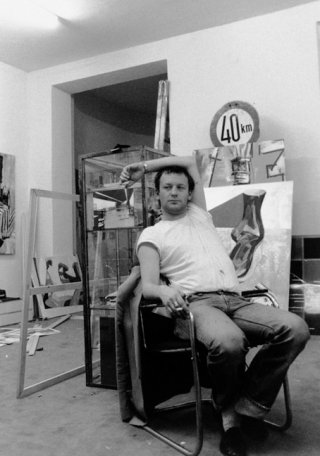
“Big show.” A retrospective look upon the artist’s career appears to be a reckless amalgamation of several different artists from across the twentieth century. We see neo-expressionism, pop art, surrealism, and traces of Dada. Paintings that I would guess to be Kirchner’s, posters that look like they are advertising a Euro-pop band’s 1982 tour, pictures that look like propaganda commissioned by the Soviet government- strewn up on walls with a loose sense of order and little regard for chronology. Without previous knowledge of the exhibition, a displayed introduction or the title plaques next to the individual works, the exhibition would come off as a very impressive private collection or the aimless attempt of a figurehead curator to display half a dozen unrelated artists. But because we know the perspective is one artist’s, comprised only of his career’s output, as one wanders across the MoMA’s sixth floor, they are likely to be stunned by the sheer mass of Martin Kippenberger’s body of work.
His retrospective really is enough to span a life three times as long as Kippenberger’s. The wide variety of work and the actual amount (nearly a thousand pieces) seem to be the basis of the title “A Problem Perspective”, as gaining some kind of artistically themed perspective is impossible. Yet the overlying theme of his work is in its social commentary. His life was themed. Kippenberger was a drunk and a prankster, a deviant, an unabashed rockstar, a notorious troublemaker. His critics spoke in unison. He was “the ultimate poseur, just a court jester with a fabulous instinct for profit”. He was never fully accepted into the art world, and at the same time an icon. Martin Kippenberger: A Problem.
And so we walk through A Problem Perspective armed with two constants. One is a smile. Whether a sign of quality or not, Kippenberger was a funny guy. His work is funny. The “shameless exhibitionism” and self-promotion in his posters is universally flippant. Sculptures like “Capri at Night” (1982) (Ford’s affordable take on a European sports car, rolled in oats, painted and signed) and “Stand in the Corner and be Ashamed of Yourself” (1990) are, if not laugh-out-loud funny, at least amusing. His alter-ego, Freddy the Frog was a muppet-esque character, except he was drunk and most famously portrayed nailed to the cross. In passing, this is a funny visual, but reflection reminds us that mockery is offensive. Freddy the Frog was not only self-deprecating but also alludes to the artists crucifixion, and maybe even martyrdom, presumably in the art world. (I suppose it should be mentioned that Pope Benedict XVI condemned this piece in 2008. ) And even with less blatant works like the aforementioned “Capri at Night”, Kippenberger is taking shots at a peer as the sculpture was a “droll riff on the highly serious brown paintings embedded with straw by Anselm Kiefer.” We might be laughing at Kippenberger’s work, but at points we are laughing as a response to confrontational audacity.
And so we walk through A Problem Perspective armed with two constants. One is a smile. The second is a perception of stylistic inconsistency. If you move counter clockwise through the exhibit, the second room of installation- and the first opportunity to see Kippenberger’s art in a traditional medium- shows paintings from the series ‘Dear Painter, Paint For Me’. Technically speaking, these may very well be ‘Kippenberger’s’ best pieces, because the heavy-handed artist commissioned somebody else to paint them. I don’t even know how that makes me feel. Are these really ‘Kippenberger’s Works’? How come I can’t even find the commissioned artist’s name? Otherwise his paintings are rather crude. One critic even stated that his paintings "offend [. . .] every kind of good, bad, and indifferent taste."
Although many academics associate Kippenberger with a post-modern Dadaism or post-modern pop art, if anything at all, I see a quintessentially German style in Kippenberger’s brush work. His ‘ugly’ style seems akin to neo-expressionists such as Baselitz and Kiefer. “Likable Communist Woman” (1983) reminds of Max Beckman. “The Mother of Joseph Beuys” (1984) screams Ernst Ludwig Kirchner. This is particularly interesting because there was an ongoing feud between Kippenberger and his country’s art culture, a mutual rejection of the other.
Although his painting style seems rather German, his spirit was not in sync with the political climate of Deutschland, as his works which delved into politics dealt with extremely delicate issues (Communism and Nazism) in an extremely indelicate manner. In “Romantic Globalization: Martin Kippenberger’s Metro-Net”, Kai Hammermeister says these specific works can be “read as Dadaistic political interventions or satirical comments on the political engagement of art.”
But as we walk through A Problem Perspective armed with two constants, we realize that our attempts to categorize Kippenberger as one kind of artist or another can not extend across his entire career. Perhaps this time, a grain of salt, a shrug of the shoulders, and an appreciation of an extraordinary and inspired volume of work will suffice.
"Martin Kippenberger: A Problem Perspective" will be at MoMA until May 11th.


Tuesday, March 10, 2009
Poetry: Demetri Martin's 224 Word Palindrome
I like Demetri Martin's new show, although the comedian sort of gives off the impression that he thinks he is smarter than everyone else. With a poem as impressive as "Dammit I'm Mad", however, I think we can agree that his thoughts are validated.
"Dammit I'm Mad"
Dammit I’m mad.
Evil is a deed as I live.
God, am I reviled? I rise, my bed on a sun, I melt.
To be not one man emanating is sad. I piss.
Alas, it is so late. Who stops to help?
Man, it is hot. I’m in it. I tell.
I am not a devil. I level “Mad Dog”.
Ah, say burning is, as a deified gulp,
In my halo of a mired rum tin.
I erase many men. Oh, to be man, a sin.
Is evil in a clam? In a trap?
No. It is open. On it I was stuck.
Rats peed on hope. Elsewhere dips a web.
Be still if I fill its ebb.
Ew, a spider… eh?
We sleep. Oh no!
Deep, stark cuts saw it in one position.
Part animal, can I live? Sin is a name.
Both, one… my names are in it.
Murder? I’m a fool.
A hymn I plug, deified as a sign in ruby ash,
A Goddam level I lived at.
On mail let it in. I’m it.
Oh, sit in ample hot spots. Oh wet!
A loss it is alas (sip). I’d assign it a name.
Name not one bottle minus an ode by me:
“Sir, I deliver. I’m a dog”
Evil is a deed as I live.
Dammit I’m mad.
found at Paste Magazine
Monday, March 9, 2009


Tuesday, February 17, 2009
Some More Cudi Drama...
Last week, we left Cudi in the Outback, infuriated about the Day N Nite video. But over the weekend, Cudi found something new to be mad about: Reeboks. The indie rapper was scheduled to play the Reebok All-Star weekend party in Pheonix on Saturday, when he got into a fight with the sneaker company's employees because he refused to change out of his Jordans and into a pair of Reeboks. The altercation escalated and the police were called. Apparently, the coppers couldn't restrain Cudi, and he was tazed and arrested.
I used to live in Arizona and I can testify that their police department is awful. Furthermore, I much prefer Jordans over Reeboks. Nevertheless, I prefer not getting tazed more than Jordans, and while I can't say I have had any first-hand experience, I am pretty sure that I prefer getting paid to perform at All-Star weekend more than any kind of sneaker. Of the relevant topics, here is my order of preference:
1) Getting paid to perform at Reebok's All-Star Weekend Party
2) Not Getting Arrested
3) Not Getting Tazed
4) Jordans
5) Reeboks
Also, it is not like I hate Reeboks. In fact, after a bit of research, I have compiled several pairs of Reeboks I would love to have in my repertoire.
Freestyle Hi (Womens but why? I love these.)
Ex-O-Fit Hi
Juun J. x Rbk Hi
RBK Basquiat Mid
In other Cudi-related news, the snippet of a new Ryan Leslie produced joint named Can I Be has been released. I am not too impressed, especially with Leslie who is usually the man, but here it seems like he just looped an LCD Soundsystem joint.
Kid Cudi - Can I Be


Monday, February 9, 2009
Chris Brown's Pimphand is STRONG
 Don't let the cuddly picture of Chris Brown and the mixed dog fool you. Dave Itzkoff noted this morning on the Times' Arts Beat Blog that "The R&B singer was arrested Sunday and charged with making criminal threats."
